Chiune Sugihara. This man saved 6000 Jews. He was a Japanese diplomat in Lithuania. When the Nazis began rounding up Jews, Sugihara risked his life to start issuing unlawful travel visas to Jews. He hand-wrote them 18 hrs a day. The day his consulate closed and he had to evacuate, witnesses claim he was STILL writing visas and throwing from the train as he pulled away. He saved 6000 lives. The world didn’t know what he’d done until Israel honored him in 1985, the year before he died.
Why can’t we have a movie about him?
He was often called “Sempo”, an alternative reading of the characters of his first name, as that was easier for Westerners to pronounce.
His wife, Yukiko, was also a part of this; she is often credited with suggesting the plan. The Sugihara family was held in a Soviet POW camp for 18 months until the end of the war; within a year of returning home, Sugihara was asked to resign – officially due to downsizing, but most likely because the government disagreed with his actions.
He didn’t simply grant visas – he granted visas against direct orders, after attempting three times to receive permission from the Japanese Foreign Ministry and being turned down each time. He did not “misread” orders; he was in direct violation of them, with the encouragement and support of his wife.
He was honoured as Righteous Among the Nations in 1985, a year before he died in Kamakura; he and his descendants have also been granted permanent Israeli citizenship. He was also posthumously awarded the Life Saving Cross of Lithuania (1993); Commander’s Cross Order of Merit of the Republic of Poland (1996); and the Commander’s Cross with Star of the Order of Polonia Restituta (2007). Though not canonized, some Eastern Orthodox Christians recognize him as a saint.
Sugihara was born in Gifu on the first day of 1900, January 1. He achieved top marks in his schooling; his father wanted him to become a physician, but Sugihara wished to pursue learning English. He deliberately failed the exam by writing only his name and then entered Waseda, where he majored in English. He joined the Foreign Ministry after graduation and worked in the Manchurian Foreign Office in Harbin (where he learned Russian and German; he also converted to the Eastern Orthodox Church during this time). He resigned his post in protest over how the Japanese government treated the local Chinese citizens. He eventually married Yukiko Kikuchi, who would suggest and encourage his acts in Lithuania; they had four sons together. Chiune Sugihara passed away July 31, 1986, at the age of 86. Until her own passing in 2008, Yukiko continued as an ambassador of his legacy.
It is estimated that the Sugiharas saved between 6,000-10,000 Lithuanian and Polish Jewish people.
It’s a tragedy that the Sugiharas aren’t household names. They are among the greatest heroes of WWII. Is it because they were from an Axis Power? Is it because they aren’t European? I don’t know. But I’ve decided to always reblog them when they come across my dash. If I had the money, I would finance a movie about them.
He told an interviewer:
You want to know about my motivation, don’t you? Well. It is the kind of sentiments anyone would have when he actually sees refugees face to face, begging with tears in their eyes. He just cannot help but sympathize with them. Among the refugees were the elderly and women. They were so desperate that they went so far as to kiss my shoes, Yes, I actually witnessed such scenes with my own eyes. Also, I felt at that time, that the Japanese government did not have any uniform opinion in Tokyo. Some Japanese military leaders were just scared because of the pressure from the Nazis; while other officials in the Home Ministry were simply ambivalent.
People in Tokyo were not united. I felt it silly to deal with them. So, I made up my mind not to wait for their reply. I knew that somebody would surely complain about me in the future. But, I myself thought this would be the right thing to do. There is nothing wrong in saving many people’s lives….The spirit of humanity, philanthropy…neighborly friendship…with this spirit, I ventured to do what I did, confronting this most difficult situation—and because of this reason, I went ahead with redoubled courage.
He died in nearly complete obscurity in Japan. His neighbors were shocked when people from all over, including Israeli diplomatic personnel, showed up at quiet little Mr. Sugihara’s funeral.
I will forever reblog this, I wish more people would know about them!
I liked this before when it had way less information. Thank you, history-sharers.
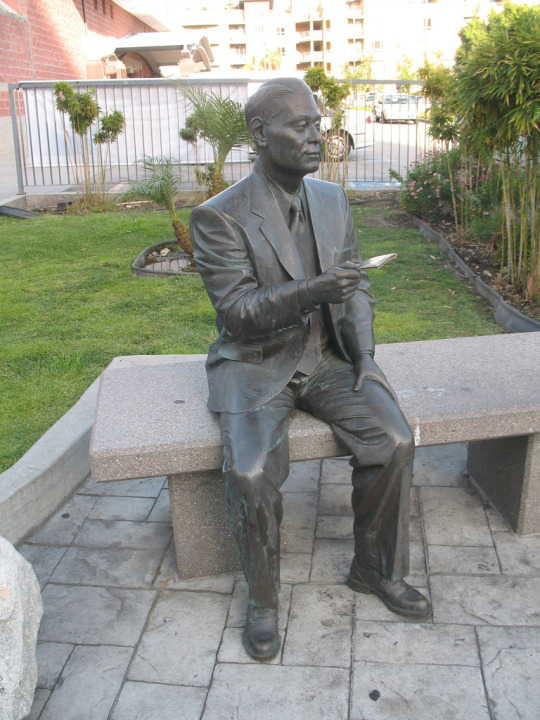
Tucked away in a corner in L.A.’s Little Tokyo is a life-sized statue of Chiune, seated on a bench and smiling gently as he holds out a visa.
The stone next to him bears a quote from the Talmud; “He who saves one life, saves the entire world.”
I had no idea it existed until a few weeks ago, but it’s since become one of my favorite pieces of public art.
lilith was created before eve from the same soil as adam to be his wife
she refused to lay beneath him, wishing to be his equal, only willing to have sex with him if she was on his side or on top
adam tried to force her to have sex with him the way he wanted, so she left him and became a demon…
…go off
i mean we could talk about how lilith was a badass who’d rather be a demon than be subservient to a man or we could talk about the allegory here where a woman who demands agency is LITERALLY demonized… or the reality that this story means that the first man in the bible (or the first man ever, if you subscribe to that) was a rapist! great start, boys
this is so important.
I wonder how different shit would be if Adam attempting to rape Lilith was the “original sin” instead of Eve eating the apple.
lilith is mentioned very vaguely in the actual hebrew bible and its complicated bc “lilit” (or “liliyyot”) can be translated as “night creatures”, “night monster”, “night hag”, or “screech owl”, and is found in isaiah only in a list of animals
lilith as a kind of demon is probably derived from an earlier class of female demons in mesopotamian religion but we are not sure. in the dead sea scrolls there is only one mention: “I, the Instructor, proclaim His glorious splendour so as to frighten and to te[rrify] all the spirits of the destroying angels, spirits of the bastards, demons, Lilith, howlers, and [desert dwellers…] and those which fall upon men without warning to lead them astray […]”
lilith is mentioned in the babylonian talmud like 3 times mostly just … various rabbis making shit up but notably theres a bit about how “HE WHO SLEEPS ALONE AT NIGHT WELCOMES LILITH” which is probably a reference to ~nocturnal emissions ~ birthing demons lol. from this we have an anecdote from R. Jeremiah b. Eleazar: “In all those years [130 years after his expulsion from the Garden of Eden] during which Adam was under the ban he begot ghosts and male demons and female demons [or night demons], for it is said in Scripture: And Adam lived a hundred and thirty years and begot a son in own likeness, after his own image, from which it follows that until that time he did not beget after his own image… When he saw that through him death was ordained as punishment he spent a hundred and thirty years in fasting, severed connection with his wife for a hundred and thirty years, and wore clothes of fig on his body for a hundred and thirty years. – That statement [of R. Jeremiah] was made in reference to the semen which he emitted accidentally.” (Babylonian Talmud on Tractate Eruvin 18b) so we have some stuff that’s supposed to warn men off having wet dreams basically (i guess, i am not actually that educated on talmudic historical context!)
notably: “Some researched work from Jewish feminists urges us to re-examine Lilith’s depiction in The Alphabet of Ben Sira, based on the fact that this text served as a source of satire at the time. Although the negativity surrounding Lilith’s character as a demoness, terrorising pregnant women, fornicating with demons, and murdering infants was taken with a varying degree of superstition within Judaism, it should not go unrecognized that these claims originated from the same source that satirically dealt with flatulence, incest, and masturbation”, also, “The background and purpose of The Alphabet of Ben-Sira is unclear. It is a collection of stories about heroes of the Bible and Talmud, it may have been a collection of folk-tales, a refutation of Christian, Karaite, or other separatist movements; its content seems so offensive to contemporary Jews that it was even suggested that it could be an anti-Jewish satire” (although in the last case its notable that the text WAS taken seriously by quite a few medieval german jewish mystics)
also notably, none of the sources listed here (and ESPECIALLY not the alphabet of ben sirach, which is, as noted, a satirical text written by WHO KNOWS WHO in the middle ages) are like. canon??? in? judaism? or christianity. the dead sea scrolls are not canon. (this sounds funny bc of fandom but like that is how one describes such things)
the idea of lilith as a demonic queen, temptress of men, killer of children, is one which developed in the middle ages as european folklore. lilith is definitely a presence in most jewish mystical texts involving demons in the mid-late middle ages, and I’m by no means saying that the way her mythology evolved is not misogynistic or has nothing to do with misogyny. however! as you can see it is a complex issue and i am not comfortable with it being simplified handily so that people can make a really really complex thing having to do with the culture & history of my people into like a Commentary On Western Misogyny. idk. ymmv.
we read the ben sirach lilith chapter in a class i took once. if it gives you an idea of how seriously the lilith story is supposed to be taken, the next story in the book is about a man who can’t stop farting.
The series, which will be fully released in October, features 70 models who identify as either Asian, Native American, Hispanic, African, Middle Eastern, Black American and West Indian.
“I think it is very important to see one’s self in the Scripture so that it may become real in their eyes,” Lewis told The Huffington Post. “The whitewashing of the Bible has always bothered me. However I’m happy to now have the opportunity to give a different point of view.”
“I wish to exhibit a splash of color onto the biblical pages of history with my creative embellishments. By doing so I hope to open the minds and eyes of the ignorant and create open conversations of how we can learn to see the world through colorful lenses. After all, the Gospel of Jesus Christ is intended for everyone.”
For those who’d like to see the entire collection, “Icons Of The Bible” will on display from November 2014 to February 2015 in Atlanta, GA.
-waits for white people to flip shit-
unfing awesome
King David and me have naked things to discuss.
This is lovely because a) whitewashing the bible is dishonest and is designed to align spiritual power with with racial power. b) Even if every single person in the whole of the bible was white, God isn’t the God of white people but of all people and depicting biblical figures as people of colour is something that promotes spiritual growth and understanding. Seeing and being able to relate to spiritual figures is vital to spiritual growth. Something that I don’t think any of said prophets would disagree with doing. And I really enjoy how the actors are more than just hot (although A++) but their faces have a lot of character.
I like to write stuff like this for fun, and I wanted to have some fun. So here is a brief guide to what’s in the Bible and the periods of Judeo-Christianity. Feel free to read, not read, or ask any questions.
The King James Bible is divided into the following sections:
The Books of Moses, also known as the Pentatuch, or the Torah: an abridgement of several thousand years into 50 chapters (Genesis) and then the matters of the Law of Moses.
The Histories: Joshua through Esther, includes some secular matters and laws alongside the spiritual and includes mention of at least one female prophet, a Judge (or holy soldier-leader) who escaped out a toilet and a lot of politics.
The Poets: Job through The Song of Solomon, there is debate in some circle whether or not the Song is scripture, as it contains mostly love letters from King Solomon to the Queen of Sheba (or Ethiopia). Many of the narratives in the Poets are figurative, and most of this section is written by David and his son Solomon.
The Prophets: Isaiah through Malachi, keep in mind, some scholars would put Isaiah with the Poets because of his unique style of writing; everything he wrote applied to ‘Ancient Israel,’ and the coming of the Messiah and the so called Last Days. However much of his writing includes commentary about events during his life, even if he used parable and symbolism to make reference to political events and figures (Isaiah, I should add, was very influential politically for a good portion of his life, although he resisted any real official political title or power), thus he can comfortably rest with the rest of the prophets.
Keep in mind many of the books in the Bible are not in chronological order, but grouped by subject, many books have overlap. Also be informed, these are not all of the books written by prophets or scribes belonging to the Judeo-Christian tradition. Because in Judeo-Christianity the priesthood, necessary for the position of prophet, followed the male line, the full linage of Christ was lost except for a few women, despite the emphasis on Christ’s female ancestors by God (for example, Eve, Ruth, and Bath-sheba). There are 21 books referenced by name that are not included in the Old Testament, and at least one more that includes a specifically worded prophecy. Some of these are the books abridged into Genesis, including the Prophecies of Enoch, Book of the Covenant, and a Book of Abraham, others belong to prophets during the Law of Moses and may have been lost during the destruction of Israel. There are also four known books left out of the New Testament.
During and after the Bible there were the following periods in Judeo-Christianity, I will include the major tenets:
Adamic – vegetarianism, stewardship, prayer, Sacrifice of the First Born of the Flocks, multiply and replenish, curse upon men ‘who sin against [humans]’ begins (ie rapists and murderers), Sacrament. These laws primarily had to do with the respect for life, and the importance of the family unit, during this time great emphasis was put on personal revelation. Enoch and Noah were during this period.
Abrahamic – Abrahamic Covenant, lineage inheritance, limits on marrying of men who were outside the Covenant, tithing, ceremonial washing referenced as happening prior to this time (some scholars consider this baptism), polygamy allowed, servants allowed in a limited degree. It is assumed by many that Abraham’s family was the only practicing the Adamic law which persisted until the Covenant (like a contract with God, you essentially sell your soul to Heaven in a very basic way) God made with Abraham. However there were many practicing in different areas. Nor was Abraham perfect, although he did strive to align himself with God. He had some trouble with the Egyptians.
Law of Moses – (the second set of) 10 Commandments (many people think Judeo-Christian doctrine starts with the 10 commandments, this isn’t true), Feasts and Sacrifices, Year of Jubilee (you can’t have a slave for more than 7 years and you must forgive all debt except Covenants (ie your grandfather saved my grandfather’s life, if you need any help just call) must be forgiven every fifteen years, Levitical Law, Circumcision, so many little laws, so many… This period included huge political upheavals, a few temples and the reign of David, considered a great King of Isreal. All but Genesis takes place in this time period in the Old Testament.
New Law (New Testament) – recant the corporal punishments of the Law of Moses, but dire warnings go to those who would ‘sin against the helpless whose tears do call out to me their God,’ spiritual instead of symbolic sacrifice, necessity of baptism, Worship God and Love thy Neighbor. This was one of the shortest periods, and the Law from the birth of Christ on is not recognised by those of the Jewish faith.
Nicene Creed – organised by order of Emperor Constantine, beginning of Catholic Law, having to do with the nature of God, later Catholic Law bans marriage in the Priesthood, or in women who’ve given themselves to God, it is during this time the books of scripture were selected for the New Testament, and minor ‘editing’ occurred (one example is the change from the word ‘organised’ to ‘created’ in Genesis chapter 1, the change from ‘the presence of the Lord’ to the ‘angel of the Lord’ in the first part of Exodus chapter three, the in chapter 4 of Exodus a possible mistranslation from a warning that ‘Pharaoh will harden his heart’ to ‘[the Lord] will harden [Pharaoh’s] heart’ to name a few) a lot of dogma changed during this period of time. Despite this it is considered that the Bible is largely accurate, or true as far as it’s translated correctly. Mary Magdalene magically became a prostitute, Eve magically became cursed by God and many political factors created the many new dogma, including that people of colour were inferior (this teaching didn’t exist before European slavery of people of colour) and the policy that a woman must be ‘cleansed’ after childbirth and that menses was unclean (this came from a commandment in the Bible that a woman in menses should be left alone and freed from any domestic responsibilities she didn’t want to perform, she was even freed from religious performances at the temple and sacrifices, this policy was twisted to imply filthiness). After the early implementation of the Nicene Creed many religious leaders refused to comply because of some of its doctrines and were quietly killed or exiled.
Protestantism – Started when Martin Luther noticed many policies of the Catholic Church were contrary to the Bible and protested. There have since sprung up many churches from the sturdy, thoughtful doctrines of the Lutheran church to the pacifist, self-disciplined worship of the Quakers and Amish. These churches often are formed because of an issue with a specific issue of doctrine and that is often but not always reflected in their name, the Baptist formed because of baptism, Methodist because of the process in certain ceremonies, Puritans because of belief in the need for absolute spiritual purity.
Reformism – Reformist Churches believe that dogma has overtaken doctrine to such a degree they reject all dogma after the Nicene creed and base their doctrines directly on the scriptures, they largely began in the early to mid 1800s. Reformists believe in personal manifestations of the Spirit, private worship, the sanctity of free will and miracles and revelations. A lot of Reformist members are influence by Nicene and Protestant worship as many in reformist churches are converts, or close descendants of converts and doctrine inside churches can vary by region and culture. Reformist churches include the Church of Jesus Christ of Latter-day Saints, nondenominational churches, ministry churches that focus on worship for people of alternative sexuality or homeless populations, and ‘country’ or Fundamentalist churches.
Apocalyptic Churches: These span from the Nicene Creed to the present day and focus almost solely on the End of the World. Many of these Churches emphasis the ability of a single person or group of people with spiritual gifts to save a congregation or to tell people of the supposed day of the end of the world and are almost always cults of personality. Apocalyptic Churches are largely independent and seldom although occasionally have multiple congregations or a set structure and often don’t last long after the death of the head of the church. Although many apocalyptic cults, or fusion cults are in this category, it’s not fair to categorize all apocalyptic churches as cults.




 Speak with Tenderness